Missed Your Florida Real Estate License Renewal? What Happens Next, Step by Step
Last checked against the statute text: 2026-10-07
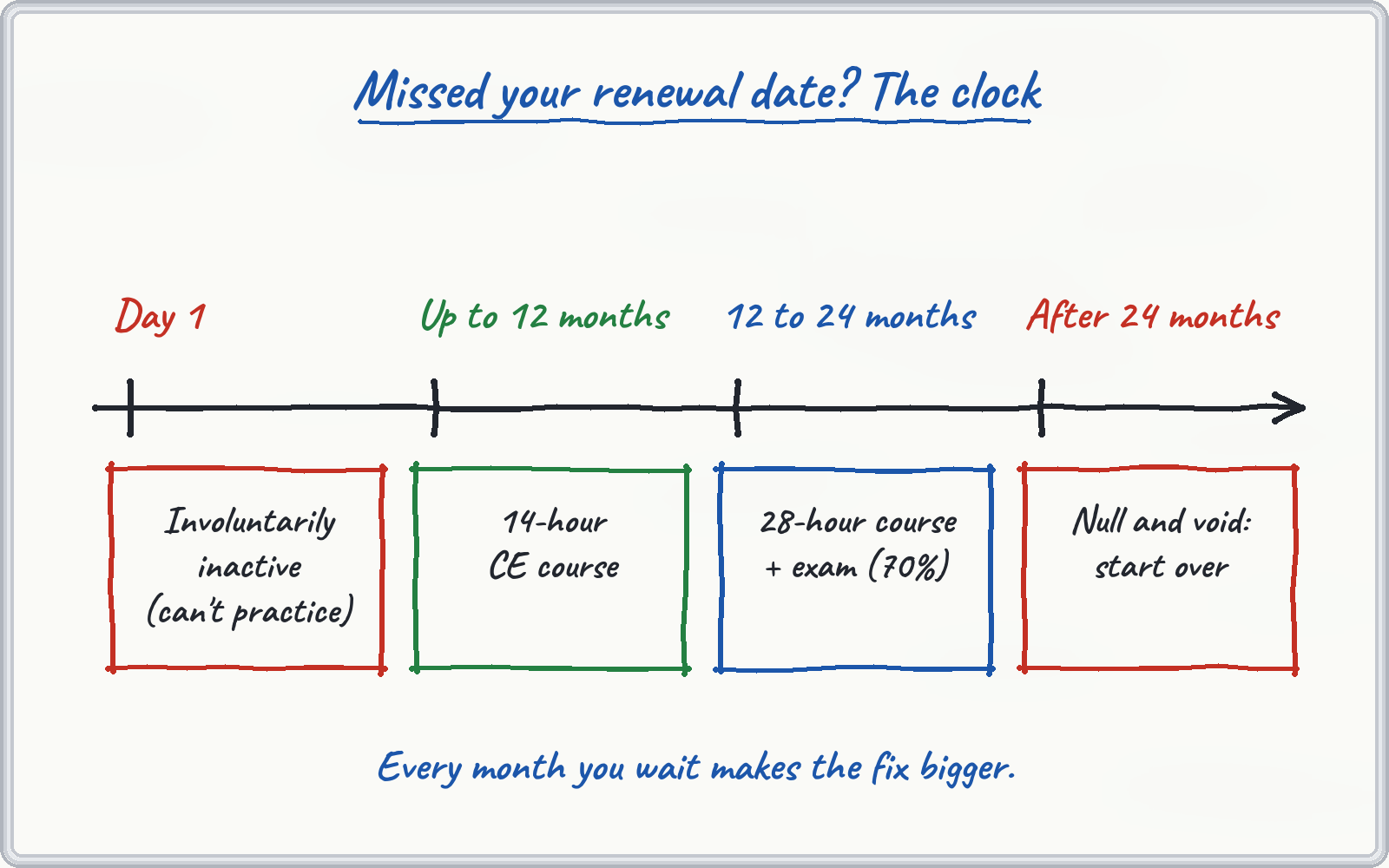
If your Florida real estate license expired without a renewal, it is not dead yet. It reverted, automatically, to involuntarily inactive status, [1] and the law gives you a two-year window to bring it back. [2] What you owe depends on how long you wait: within the first 12 months it is a 14-hour continuing education course, [3] between 12 and 24 months it is a 28-hour reactivation course, [3] and past two years the license expires and becomes null and void. [3]
That is the map. What follows is each stage in order, with the statute, the Commission's rule and DBPR's own notice quoted, because the stakes at the far end are a brand-new pre-license course and the state exam.
Stage one: the day after your expiration date
You cannot practice. An involuntarily inactive license is not a license to sell real estate, and the switch happens the moment the license period ends, with no letter required. [1] The clock on your two years also starts that day: the rule defines the first day of the allowable period as the first day you failed to hold a valid and current active or voluntarily inactive license. [2]
A word about vocabulary, because it trips people who look up the general DBPR rules. Most professions regulated by DBPR go "delinquent" when they miss a renewal; the general statute says failure to renew before the license expires makes the license delinquent in the following cycle. [4] Real estate is carved out of that section entirely: it does not apply to a person licensed under chapter 475. [4] For real estate licensees the governing words are "involuntarily inactive," and the governing section is 475.183. If someone tells you about "delinquent status," they are describing a different profession's rules.
Stage two: the first twelve months, the cheap fix
Inside the first year, reactivation costs you the same education you would have taken anyway. The statute lets a licensee who has been involuntarily inactive for 12 months or less reactivate by completing at least 14 hours of a Commission-prescribed continuing education course. [3] That is the ordinary 14-hour course, Core Law, Business Ethics and specialty hours, the one you would have finished before the deadline. Take it, pay the renewal fee plus whatever late fee applies, and the license comes back.
There is money owed for the gap. The department collects the current renewal fee for each renewal period in which the license was involuntarily inactive, in addition to any applicable late renewal fee. [3] The statute caps the late fee the Commission may set at $100, [3] and DBPR's current renewal notice to active licensees names a $25 late fee for a renewal that arrives after the deadline. [5] The exact figure you owe is whatever your DBPR account shows when you renew.
Stage three: months twelve to twenty-four, the 28-hour course
Once you are more than a year out, the 14-hour course no longer qualifies. The statute requires 28 hours of a Commission-prescribed education course for a license that has been involuntarily inactive for more than 12 months but fewer than 24 months. [3] The rule explains what that course is: 28 hours derived from the Florida Real Estate Commission Salesperson Course Syllabus, FREC Course I, [2] which is the pre-license course you took at the start of your career. The reactivation course is a focused refresher of it.
The rule lists the sessions the course must cover: license law and qualifications for licensure, license law and Commission rules, authorized relationships and disclosure, brokerage activities and procedures, violations and penalties, federal and state laws pertaining to real estate, contracts, computations and closing, and investments and business opportunity brokerage. [2] In plain terms: the law, the rules, agency, brokerage practice, contracts, math and closings.
Unlike the 14-hour course, this one ends in a real exam. You demonstrate completion by scoring 70% or higher on the Commission-prescribed end-of-course examination. [2] The exam carries two items per instructional hour or a minimum of 50 questions, [2] and the school may only test students who have completed at least 90% of the required hours. [2] If you fail, you may retest once within one year of the original examination; otherwise you repeat the course before testing again. [2]
DBPR's notice to involuntarily inactive licensees says the same thing without the citations: you are required to complete the 28-hour reactivation education course and pay the required renewal fee in order to renew. [6] Two practical warnings from that notice are worth reading twice. If you paid online for the last renewal and the license failed to renew anyway, you cannot pay online this time and must mail the payment, [6] and for the current group, all reactivation education and payments must be completed by September 30, 2026. [6]
Passing the course does not by itself flip the switch. The rule says completion will not entitle anyone to reactivate until all other requirements of law are met, [2] which in practice means the fee, the back fees and the renewal application itself.
Stage four: the two-year cliff
This is the part that cannot be undone with a course. A license involuntarily inactive for more than two years automatically expires and becomes null and void without any further action by the Commission or the department. [3] The rule puts it as the right to request an active or voluntarily inactive license expiring by operation of law after the second year. [2]
DBPR does warn you first. Ninety days before expiration the department gives notice to the licensee, [3] and its involuntary-inactive notice says in so many words that it is the last renewal notification you will receive before the license is set to null and void, [6] and that a renewal postmarked or received after the deadline means the license becomes null and void. [6] After that, the route back is the one every new agent takes: the pre-license course and the state exam.
The hardship exception, and what it actually covers
There is one narrow door past the cliff. The Commission may reinstate a void license if it determines the person failed to comply because of illness or economic hardship as defined by rule, and the application must be made within six months after the date the license became void. [3] The rule mirrors it with an additional six-month period for licensees who cannot complete the reactivation requirements due to individual hardship, [2] requested in writing with the basis set out. [2]
Hardship has a definition, and "I forgot" is not in it. The rule counts a licensee's long-term illness or an illness involving a close relative or someone the licensee cares for, [7] a required course that is not reasonably available, [7] or an economic or technological hardship that substantially relates to the ability to complete the education. [7] Even with an extension granted, the license remains null and void until a valid reinstatement application arrives with proof of the renewal fees and the reactivation education. [2]
What to do today, by how long it has been
| Time since your expiration date | Do this |
|---|---|
| Under 12 months [3] | Take the 14-hour course now, then renew in your DBPR account and pay the fee plus any late fee. Your license comes back active or voluntarily inactive, your choice. |
| 12 to 24 months [3] | Take the 28-hour reactivation course and pass its exam, then renew and pay the fees for the periods you missed. Watch the mail-in rule if your last online payment failed. |
| Approaching 24 months [2] | Do not wait for the next notice. Enroll this week; the course has an exam and a one-retest limit. [2] |
| Past 24 months [2] | The license is void. If a defined hardship applies, write to the Commission within the six-month window. [3] Otherwise, the pre-license course and the state exam. |
Frequently asked questions
Can I keep working while I sort this out? No. Only an active license lets you perform real estate services, and yours reverted to involuntarily inactive on the expiration date. [1]
I never got the renewal notice. Does that extend my deadline? No. The notice goes to the last known address on file, [1] and the dates run from the expiration date regardless.
Is the 28-hour course harder than the 14-hour course? It is longer and it ends in a graded exam with a 70% pass mark, [2] but it is a refresher of material you have already learned once.
Can I take the 28-hour course online? Yes. The rule treats a distance learning 28-hour course on a classroom-hour-for-classroom-hour basis, [2] with the same exam.
Will I owe the renewal fee for the years I was inactive? Yes. The department collects the current renewal fee for each period the license was involuntarily inactive, plus any late fee. [3]
Past 12 months? The 28-hour reactivation course is the one you need
SFCC's DBPR-approved 28-hour reactivation course is online and self-paced for $99, with the end-of-course exam included and your certificate issued when you pass. Inside 12 months, the 14-hour course is enough: online for $40 or live on Zoom for $99.
See the 28-hour reactivation course →
Sources
- Florida Statutes, section 475.182: Renewal of license; continuing education
- “Any license that is not renewed at the end of the license period prescribed by the department shall automatically revert to involuntarily inactive status”
- “the department shall mail a notice of renewal and possible reversion to the last known address of the licensee”
- Rule 61J2-3.010, Florida Administrative Code: License Reactivation Education for Brokers and Sales Associates
- “Brokers and sales associates holding an involuntarily inactive license may only maintain this status for 2 years”
- “The first day of this allowable 2-year period is the first day the broker or sales associate failed to hold a valid and current active or voluntarily inactive license”
- “A licensee may reactivate a license that has been involuntarily inactive for more than 12 months but less than 24 months by satisfactorily completing 28 hours of a Commission-prescribed education course derived from the Florida Real Estate Commission Salesperson Course Syllabus (FREC Course I)”
- “The course shall contain coverage of the following topics: Real Estate License Law and Qualifications for Licensure (Session 2); Real Estate License Law and Commission Rules (Session 3); Authorized Relationships, Duties and Disclosure (Session 4); Real Estate Brokerage Activities and Procedures (Session 5); Violations of License Law, Penalties and Procedures (Session 6); Federal and State Laws Pertaining to Real Estate (Session 7); Real Estate Contracts (Session 11); Real Estate Related Computations and Closing of Transactions (Session 14); and Real Estate Investments and Business Opportunity Brokerage (Session 17)”
- “A licensee may demonstrate satisfactory completion for reactivation by achieving a grade of 70% or higher on the Commission-prescribed end-of-course examination”
- “The end-of-course examination shall contain 2 items per instructional hour or a minimum of 50 questions”
- “The school shall test only students who have completed at least 90% of the required hours of instruction”
- “Students failing the Commission-prescribed end-of-course examination may retest a maximum of one time within one year of the original examination”
- “Satisfactory completion of these courses will not entitle any person to reactivate an involuntary inactive license as a real estate broker or sales associate until such person has met all other requirements of law”
- “After the second year, the broker's or sales associate's right to request an active or voluntarily inactive license automatically expires, by operation of law”
- “The Commission will allow an additional 6-month period after the expiration of a license for brokers and sales associates who cannot complete the reactivation requirements due to individual hardship”
- “Any licensee requesting a hardship shall make the request to the Commission in writing setting forth the basis of the alledged hardship”
- “Any licensee who has received a hardship extension will remain null and void until a valid reinstatement application for is received with proof of renewal fees and reactivation education”
- “Distance learning study must be offered on a classroom hour per classroom hour basis”
- Florida Statutes, section 475.183: Inactive status
- “A licensee may reactivate a license that has been involuntarily inactive for 12 months or less by satisfactorily completing at least 14 hours of a commission-prescribed continuing education course”
- “a licensee may reactivate a license that has been involuntarily inactive for more than 12 months but fewer than 24 months by satisfactorily completing 28 hours of a commission-prescribed education course”
- “Any license that has been involuntarily inactive for more than 2 years shall automatically expire. Once a license expires, it becomes null and void without any further action by the commission or department”
- “The department shall collect the current renewal fee for each renewal period in which the license was involuntarily inactive in addition to any applicable late renewal fee”
- “The commission shall prescribe by rule a fee not to exceed $100 for the late renewal of an involuntarily inactive license”
- “Ninety days prior to expiration of the license, the department shall give notice to the licensee”
- “The commission may reinstate the license of an individual whose license has become void if the commission determines that the individual failed to comply because of illness or economic hardship, as defined by rule. The individual must apply to the commission for reinstatement within 6 months after the date that the license becomes void”
- “The individual must apply to the commission for reinstatement within 6 months after the date that the license becomes void”
- Florida Statutes, section 455.271: Inactive and delinquent status (the general rule for DBPR professions, which carves out chapter 475)
- “Failure of a licensee to renew before the license expires shall cause the license to become delinquent in the license cycle following expiration”
- “This section does not apply to a business establishment registered, permitted, or licensed by the department to do business or to a person licensed, permitted, registered, or certified pursuant to chapter 310 or chapter 475”
- DBPR Division of Real Estate, Renewal Information for current licensees expiring September 30, 2026
- “If your renewal is postmarked after September 30, 2026, or received electronically after Midnight Eastern Standard Time (EST), September 30, 2026, you will be assessed a $25 late fee”
- DBPR Division of Real Estate, Renewal Information for involuntary inactive licensees expiring September 30, 2026
- “You are required to complete the 28 hour reactivation education course and pay the required renewal fee in order to renew”
- “If you paid online for the last renewal and your license failed to renew - you cannot pay online this renewal period. You must submit this renewal payment by mail”
- “All reactivation education courses and payments must be completed by September 30, 2026”
- “This is the last renewal notification that you will receive before your license is set to null and void”
- “If your renewal is postmarked after September 30, 2026, or received electronically after Midnight Eastern Standard Time (EST), September 30, 2026, your license will become null and void”
- Rule 61J2-3.013, Florida Administrative Code: hardship defined
- “A licensee's long term illness or an illness involving a close relative or person for whom the licensee has care-giving responsibilities”
- “The required course is not reasonably available”
- “The licensee has an economic or technological hardship that substantially relates to the ability to complete education requirements”
Photos: Quilia / Unsplash.