Florida Real Estate Mutual Recognition: the Nine States, the 40-Question Law Exam and What You Still Owe
Last checked against the statute text: 2026-10-07
If you hold an active real estate license in Alabama, Arkansas, Connecticut, Georgia, Kentucky, Mississippi, Nebraska, Rhode Island or West Virginia, Florida will recognize it: you skip the 63-hour pre-license course and the full state exam, and instead pass a written Florida-specific real estate law exam of 40 questions, where 30 points passes. [1] That is mutual recognition. It is not reciprocity, it applies only to nonresidents, and once you have the Florida license you owe Florida's post-license course before your first renewal like every other new licensee. [1]
Here is the whole arrangement, quoted from DBPR's mutual recognition page and the statute behind it.

What mutual recognition is, in DBPR's words
The purpose is to credit the work you already did. DBPR says the intent of these agreements is to recognize the education and experience that real estate licensees have acquired in another state, [1] and that the agreements apply to nonresidents licensed in other jurisdictions. [1] The statute gives the Commission the power to sign them: it may enter into written agreements with the licensing authorities of other states to ensure Florida licensees comparable nonresident licensure opportunities elsewhere. [2] The agreements run both ways; DBPR notes they also ensure Florida licensees equal opportunity for licensure in those jurisdictions. [1]
The list of states is set by those agreements, not by statute, so check DBPR's page before you rely on it. As of this writing it names nine: Alabama, Arkansas, Connecticut, Georgia, Kentucky, Mississippi, Nebraska, Rhode Island and West Virginia. For each one the page opens the same way, "Florida has mutual recognition with" that state. [1]
The requirements, state by state (they are nearly identical)
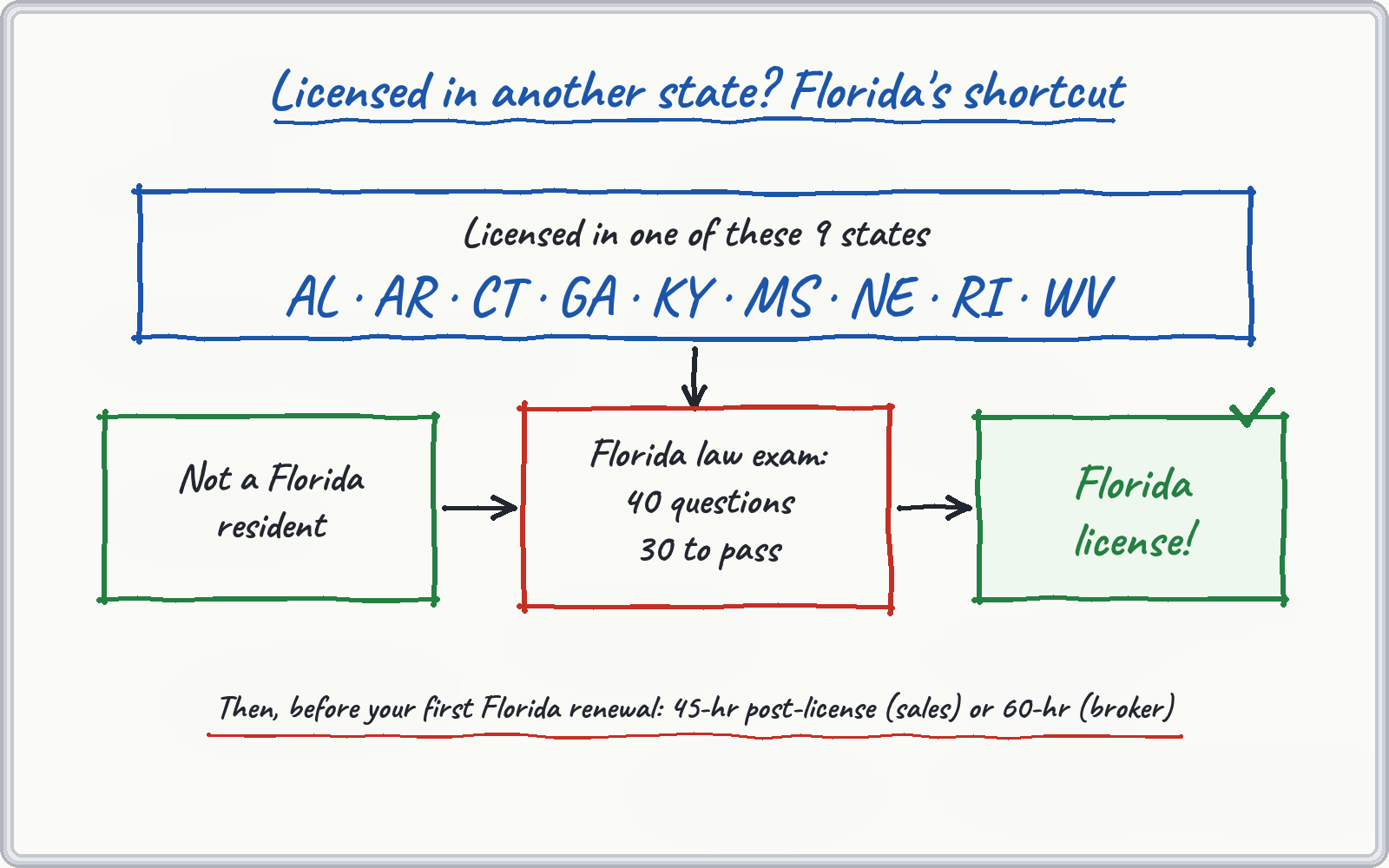
For every listed state, brokers and sales associates can qualify for an equivalent type of Florida license if they meet the qualifications DBPR lists. [1] Those qualifications are:
- Age and education. You must be 18 years of age and hold a high school diploma or its equivalent. [1]
- Not a Florida resident. The applicant must not be a resident of Florida at the time of application. [1] If you have already moved, you are no longer eligible under mutual recognition; see the section below.
- A real license, earned in that state. You must have obtained the license by meeting the education and examination requirements of your state, and you must hold a valid, current and active license in good standing issued by that state's licensing agency. [1] Inactive or expired licenses do not qualify.
- Not a license you got by reciprocity. DBPR is explicit: licensees cannot claim mutual recognition if they obtained their license in the mutual state by reciprocity. [1] A Georgia license you earned by passing Georgia's exam counts; a Georgia license you were handed because of a Tennessee license does not.
One wrinkle for brokers from two states. DBPR adds that Alabama licensees applying as brokers must have held an active broker's or sales associate's license for at least 24 months during the preceding five years, [1] and it states the same additional requirement for Arkansas brokers. [1] It is a broker rule for those two states, not a general experience requirement for every applicant.
The Florida law exam
Every mutual recognition applicant takes it. DBPR: each licensee who applies for Florida licensure from a state with a current mutual recognition agreement must pass a written Florida-specific real estate law examination. [1] The exam consists of 40 questions worth 1 point each, and a grade of 30 points or higher passes. [1] In practice that is Chapter 475 of the Florida Statutes and the Commission's rules in Chapter 61J2: license law, brokerage relationships and disclosures, escrow, advertising, violations and penalties. The national principles you already know are not retested.
You apply on the mutual recognition version of the sales associate application, which DBPR lists separately from the standard one. [3] Once DBPR approves the application you reserve the law exam with Pearson VUE, the same vendor that gives the full exam. [4]
What you still owe after you are licensed
Mutual recognition gets you in the door; it does not change what Florida asks of a new licensee afterward. DBPR says it on the same page: once you have obtained a Florida sales associate or broker license you are subject to all renewal requirements for our state, [1] which means post-license education before your initial expiration date, 45 hours for sales associates and 60 hours for brokers, [1] and 14 hours of continuing education every two years after that. [1] DBPR notifies you within 60 days before your expiration date that renewal is due, [1] and the education requirements are in addition to the renewal fees. [1]
The post-license deadline is the one that bites transferring agents, because it is unlike anything most states require: miss it and the Florida license becomes null and void. Our guide to the 45-hour post-license deadline explains it.
If you already moved to Florida
The residency test is checked at the time of application. [1] If you have become a Florida resident before applying, mutual recognition is closed to you and the standard route applies: the 63-hour pre-license course, the application, fingerprints and the full state exam. The one shortcut left is education-based, not license-based: a 4-year degree or higher in real estate may exempt you from the pre-license course. [4] Our guide to getting a Florida license from scratch walks through that path.
Residency also matters after licensure in the other direction. A Florida resident licensee who becomes a nonresident must notify the Commission within 60 days of the change and comply with nonresident requirements, [2] and failing to do so is a violation of the license law.
Frequently asked questions
My state is not on the list. Is there any shortcut? No license-based one. You take the standard path, and only a 4-year degree in real estate shortens it. [4]
Is mutual recognition the same as reciprocity? No. Reciprocity would accept your license as-is; mutual recognition still requires the Florida law exam, [1] and licenses obtained by reciprocity elsewhere are excluded. [1]
Do I need Florida experience as a sales associate? No. The experience condition applies only to broker applicants from Alabama and Arkansas. [1]
Do I have to take the 63-hour course later? No. You owe the post-license course instead, before your first Florida renewal. [1]
Can I keep my home-state license? Mutual recognition is built for nonresidents who stay licensed at home; DBPR's agreements apply to nonresidents licensed in other jurisdictions. [1] Check your home state's rules on holding a second license.
Moving your license to Florida?
Our mutual recognition page lists each state's requirements, what the Florida law exam covers, and the post-license course you will owe before your first Florida renewal. SFCC's 45-hour post-license course is online for $179 or live on Zoom for $349.
See the mutual recognition page →
Sources
- DBPR, Florida Real Estate Commission: Mutual Recognition Information (state by state)
- “The exam consists of 40 questions of 1 point in value per question. A grade of 30 points or higher must be achieved to pass the exam”
- “Prior to your initial expiration date listed on your license, you will be required to complete post license education. (45 hours Post-Education for Sales Associates and 60 hours Post-Education for Brokers)”
- “The intent of these agreements is to recognize the education and experience that real estate licensees have acquired in another state”
- “These agreements apply to nonresidents licensed in other jurisdictions”
- “These agreements also ensure that Florida licensees have equal opportunity for licensure in those jurisdictions with which agreements are concluded”
- “Florida has mutual recognition with Alabama”
- “Brokers and Sales Associates can qualify for an equivalent type license in Florida if they meet the following qualifications”
- “Must be 18 years of age and hold a high school diploma or its equivalent”
- “Applicant must not be a resident of Florida, at time of application”
- “Applicant must hold a valid, current and active real estate license, in good standing, issued by the Real Estate licensing agency in the state of Alabama”
- “Licensees can not claim mutual recognition if they obtained their license, in the mutual state, by reciprocity”
- “Alabama Real Estate licensees must have held an active broker's or sales associate's license for at least 24 months during the preceding five years if the applicant is a broker”
- “Arkansas Real Estate licensees must have held an active broker's or sales associate's license for at least 24 months during the preceding five years if the applicant is a broker”
- “Each licensee who applies for Florida licensure from a state or jurisdiction that has a current mutual recognition agreement with Florida must pass a written Florida-specific real estate law examination”
- “Once you have obtained a Florida Real Estate sales associate or broker license you are subject to all renewal requirements for our state”
- “There after you will be required to complete 14 hours of continuing education biannually”
- “You will be notified within 60 days prior to your expiration date that you are due for renewal”
- “The education requirements are in addition to applicable renewal fees”
- Florida Statutes, section 475.180: Nonresident licenses
- “the commission in its discretion may enter into written agreements with similar licensing authorities of other states, territories, or jurisdictions of the United States or foreign national jurisdictions to ensure for Florida licensees nonresident licensure opportunities comparable to those afforded to nonresidents by this section”
- “Any resident licensee who becomes a nonresident shall, within 60 days, notify the commission of the change in residency and comply with nonresident requirements”
- DBPR, Florida Real Estate Commission division page (application links and renewal rules)
- “Sales Associate Mutual Recognition (RE 1)”
- DBPR Online Services: Sales Associate Initial Application (RE 1) requirements checklist
- “The examination is given by Pearson Vue”
- “If you hold a 4 year degree, or higher, in real estate you may be exempt from the pre-license education requirement”
Photos: Vitaly Gariev / Unsplash, Nivaldo Martins / Unsplash.