Florida 14-Hour Real Estate CE: Online or Live on Zoom? How to Choose
Last checked against the statute text: 2026-10-07
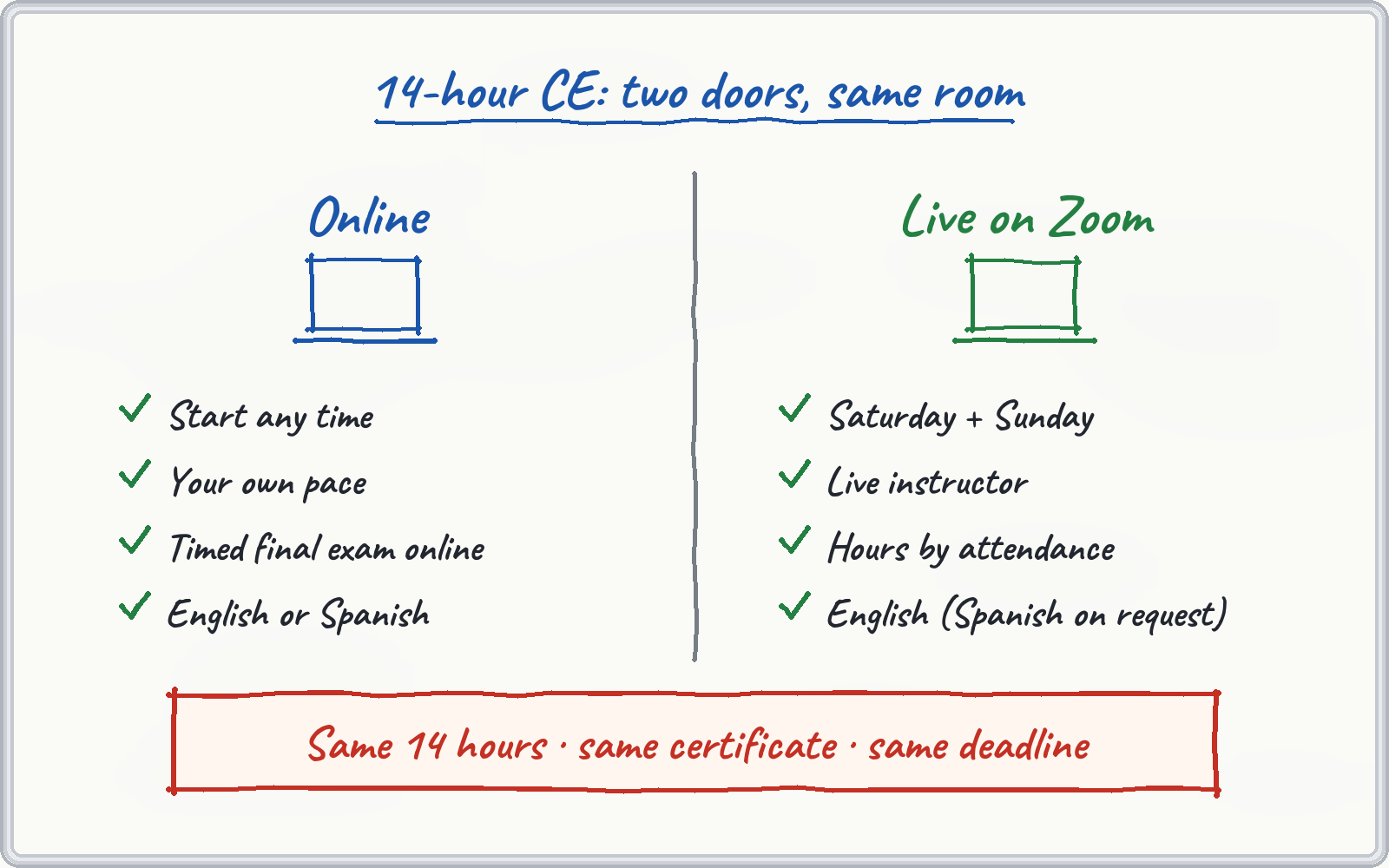
If you need your Florida 14-hour continuing education and you are deciding between an online course and a live class on Zoom, the short answer is that the state treats both as valid, the certificate you receive is the same, and the choice comes down to how you learn and when you have the time. The statute allows an approved distance learning course to satisfy the requirement, [1] and the Commission's rule counts hours delivered live by an instructor in a classroom or by live streaming or any means of video conferencing technology as classroom hours. [2] Zoom is video conferencing technology. A self-paced course is distance learning. Both doors lead to the same room.
What follows is the honest comparison we give students who call and ask, with the rules quoted so you can see where the lines actually are.

What is identical in both formats
The requirement. Fourteen hours of instruction of 50 minutes each, during each renewal period after your first one, for active and inactive licensees alike. [2] The rule says explicitly that a 50-minute hour in a distance learning course is the equivalent of the 50-minute classroom hour in a classroom course. [2] Nobody gets a shorter course for choosing a format.
The content. Every cycle includes the 3-hour Core Law course [2] and the 3-hour Business Ethics course, [2] which together earn six hours of credit, [2] plus specialty hours to reach the total. The online and the Zoom versions of SFCC's course teach the same units in the same order.
The deadline. Fee and education are both due by midnight Eastern time on your expiration date, March 31st or September 30th. [3] The format does not buy you a day.
The certificate and your duty to keep it. Whichever way you finish, you must retain the course completion certificate as proof for at least five years. [4] A PDF certificate from an online course and one from a Zoom class carry the same weight.
What actually differs
| Online, self-paced | Live on Zoom | |
|---|---|---|
| When | Any hour, any day; start the moment you enroll | A scheduled weekend class, Saturday and Sunday |
| Pace | Yours; pause and resume | The instructor's; the class moves together |
| Interaction | Reading, knowledge checks, a final exam | A live instructor you can ask questions |
| Exam | A timed final exam online; no monitored test center is allowed by law for distance learning [1] | Attendance-based classroom hours [2] |
| Language at SFCC | English or Spanish edition | English, with Spanish support on request |
| Price at SFCC | $40 | $99 |
| Best for | People who learn by reading and want it done this week | People who learn by listening and want someone to answer the odd question |
How the law defines each format
The rule defines distance learning as the delivery of education offerings or courses by correspondence or via the internet and other interactive electronic media, [2] and it requires such courses to be interactive, with registration, evaluation and monitoring of students. [2] That is why a real online course has knowledge checks and a final exam rather than a single "I read it" button, and why the state never approved a course you could finish by clicking through pages.
On the live side, a school that wants to run a course by live streaming has to tell the state how. The rule requires any school requesting approval for a live streaming course to submit all course materials and information on the delivery method and software platform. [2] A Zoom class from an approved school is therefore not an informal substitute for the classroom; it is the classroom, filed with DBPR under that delivery method.

Who should take the online course
Choose online if your week is unpredictable, if you are the kind of person who reads faster than an instructor talks, or if you want the hours finished before the weekend. Students who travel between offices, parents working around school pickups and agents in the middle of a closing stretch tend to pick this one. It is also the format to pick if you prefer to study in Spanish, since SFCC's online course has a Spanish edition under the same DBPR approval.
Choose online, too, if your deadline is close. The fee and the education must both be in by midnight of your expiration date, [3] and a self-paced course does not make you wait for the next scheduled class.
Who should take the live Zoom class
Choose Zoom if you retain more from hearing a person explain things, if you have questions about how a rule applies to your actual deals, or if you simply know you will not sit down and do a self-paced course on your own. A live class gives you a fixed appointment and an instructor who has taught the material many times and knows which parts trip people up. Licensees who have been away from practice for a while often prefer it for exactly that reason.
Choose Zoom, as well, if you want the course done in one weekend and off your mind. Two days, one certificate.
The one thing neither format changes
Approval. The 14 hours must come from a course the Commission prescribed or approved. [2] Before you pay anyone, check that the school is a DBPR-permitted real estate school and that the course is approved for Florida continuing education. A cheap course that is not approved is not a bargain; it is fourteen hours you will have to do again.
Frequently asked questions
Is an online course "less official" than a classroom? No. The statute names distance learning as an acceptable route, [1] and the rule makes its hours equivalent to classroom hours. [2]
Do I have to go to a testing center for the online exam? No. The law forbids requiring a monitored exam at a centralized location for a distance learning course. [1] You take the timed exam online.
Can I split the hours, some online and some on Zoom? You can, as long as every piece is an approved course and the pieces add up to the required content. In practice one complete 14-hour course is simpler and produces one certificate instead of several.
Does the Zoom class count if my camera is off? The rule counts hours delivered live while students are in attendance. [2] Attendance is what the school records; follow your school's attendance procedure for the class.
Which one is faster? Online, if you start today. Zoom, if the next class is this weekend and you would otherwise put it off.
Pick your format and finish this week
The same DBPR-approved 14-hour course, two ways: online and self-paced for $40, in English or Spanish, or live on Zoom over one Saturday and Sunday for $99. Your certificate is issued when you finish.
Sources
- Florida Statutes, section 475.182: Renewal of license; continuing education
- “including an approved distance learning course”
- “the commission may not require, for the purpose of satisfactorily completing an approved correspondence or distance learning course, a written examination that is to be taken at a centralized location and is to be monitored”
- Rule 61J2-3.009, Florida Administrative Code: Continuing Education for Active and Inactive Broker and Sales Associate Licensees
- “Classroom hours are the hours delivered live by an instructor in a classroom or by live streaming or any means of video conferencing technology while students are in attendance at permitted or approved school locations”
- “All persons holding active or inactive licenses as brokers or sales associates must satisfactorily complete a minimum of 14 hours of instruction of 50 minutes each as the Commission has prescribed or approved during each license renewal period excluding the first renewal period of their current license”
- “50 minute hours for distance learning courses shall be the equivalent of the 50 minute classroom hour in a classroom delivery course”
- “Licensees must take the 3-hour Core Law course once during each renewal period”
- “must also take the 3-hour Business Ethics course once during each licensure renewal period”
- “Licensees who complete the Core Law course and Business Ethics course will receive 6 hours credit toward the 14 hour requirement”
- “Distance learning means the delivery of education offerings or courses by correspondence or via the internet and/or other interactive electronic media”
- “Such offerings or courses shall be interactive, providing for the interchange of information between the student and instructor, and shall provide for the registration, evaluation, and monitoring of students”
- “Any school or provider requesting approval for a live streaming course must submit to the DBPR at the time of course submission all course materials as well as information on the delivery method and software platform being used”
- DBPR, Florida Real Estate Commission: Fees and Education for Renewal
- “Both the Fee and Education Requirements for renewal are due no later than midnight Eastern Standard Time of the expiration date (March 31st or September 30th)”
- Rule 61J2-3.015, Florida Administrative Code: Notices of Satisfactory Course Completion
- “Each licensee and instructor permitholder shall retain the course completion certificate as proof of successful completion of continuing education or pre-or post-license education requirements for at least 5 years following completion of the course”